THE RESOURCE LIBRARYBeauty Advice You Can Come Back To.
Simple routines, makeup answers, beauty-bag ideas, and little reminders that beauty can feel fun, easy, and completely your own.

Start with the question that feels useful today, take what helps, and come back anytime you need a little beauty advice from a friend.
A Simple Makeup-Prep Routine for Busy Mornings
Makeup is optional. Clear skin is not a requirement for a beautiful look. This simple guide offers a calm, flexible makeup-prep routine for busy mornings.
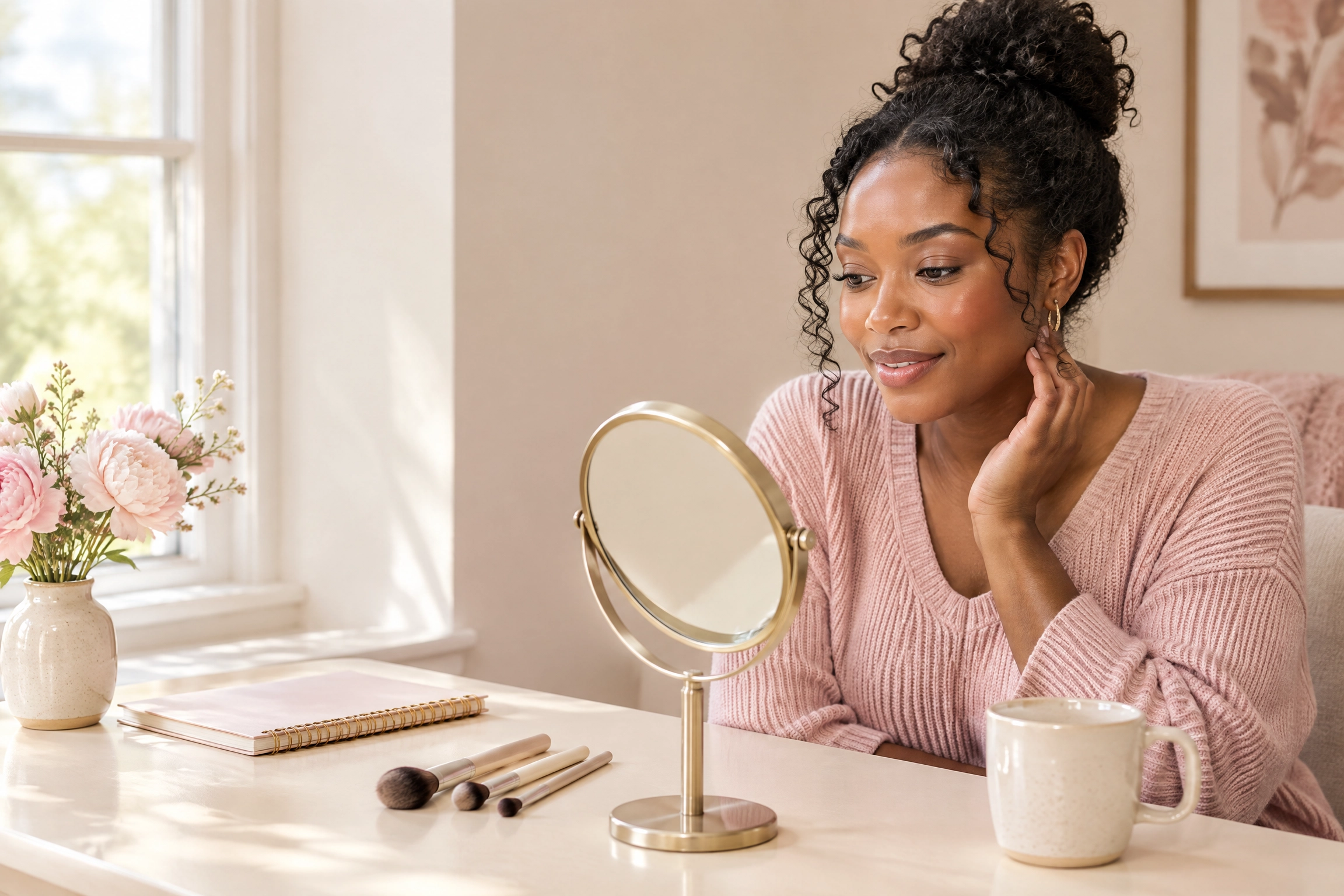
A woman in a blush-pink sweater sits at a cream desk with a tabletop mirror, makeup brushes, flowers, and a mug during a quiet morning beauty routine.
Hello Beautiful. Let’s make one thing clear before we start: makeup is optional, and clear skin is not a requirement for looking beautiful.
A makeup-prep routine is not about correcting your face or chasing a flawless result. It is simply a small, repeatable way to begin with skin that feels comfortable, then choose the makeup steps that feel right for your day.
Some mornings leave room for a little beauty time. Other mornings call for a routine that is simple, quick, and still makes you feel like yourself. Both are beautiful. The goal is not to add more steps. It is to make fewer decisions.
The Easy Order to Remember
If you ever find yourself standing in front of the mirror wondering, “What goes on first?” keep this simple order in mind:
Cleanse or refresh your skin.
Use any treatment or medication you already use, following its directions.
Apply moisturizer and/or sunscreen if it is part of your routine.
Give your routine a brief moment to settle.
Add makeup if you want to.
That basic sequence follows the American Academy of Dermatology’s general order for skin-care products: wash, apply treatment if used, apply moisturizer and/or sunscreen, then apply makeup if desired.
You do not need every possible step every morning. Think of this order as a helpful starting point, not a rulebook. Your own product directions and your comfort always matter.
What You Actually Need and What is Optional
The beauty world can make a five-minute routine sound like a twenty-step project. It does not have to be that way.
Your essentials are simple: the routine you already use, clean hands, a few minutes, and one makeup priority if you want makeup that day.
Everything else is optional: primer, a full face of foundation, powder, contour, blush, eyeshadow, liner, lashes, or a detailed lip. Those things can be fun. They are not requirements for being put together.
Primer is optional, too. If you enjoy using it or like the way it fits into your routine, use it. If your regular skin preparation and makeup already feel good to you, you do not need to add a primer simply because someone else does.
Choose the Version That Fits Your Morning
The Two-Minute Version
This is for the mornings when you need to move quickly but still want a small moment for yourself.
1.Cleanse or refresh in the way that fits your usual routine.
2.Apply the products you already use according to their directions.
3.Choose one makeup priority, if you want one.
Your one priority might be a touch of complexion coverage, brows, mascara, a lip color, or simply a quick mirror check before you leave. Pick the step that helps you feel most like yourself and let that be enough.
The Five-Minute Version
This is your realistic everyday option: enough time to feel prepared, without turning the morning into a project.
Complete your regular skin-preparation steps.
Give moisturizer, sunscreen, or another product in your routine a brief moment to settle.
Choose a complexion step if you want one.
Add one supporting detail, such as brows, mascara, blush, or lip color.
A helpful question is: What would make me feel finished today? Your answer may be different on a workday, a video-call day, a school-drop-off morning, or a day when you simply want a little more color.
The Ten-Minute Version
This is for the days when you have enough time to enjoy the process a little more.
Complete your usual skin preparation.
Choose the complexion look you want: light, natural-looking coverage; coverage in a few areas; or a more polished base.
Add definition where you enjoy it most. That could be brows, lashes, cheeks, lips, or eyes.
Take one last look in the mirror near a window or in even lighting, if possible, and adjust only if you want to.
The extra time is there to enjoy, not to create a new standard for every morning.
If Foundation is Part of Your Plan
Foundation can be one of the easiest places to overthink a routine. Let’s make it simpler.
Start Small
Begin with a small amount. You can always add more where you want it. Starting with a lighter layer gives you room to decide whether you want more coverage instead of feeling committed to a full face right away.
Choose the Finish You Want - Not the Finish You Think You “Should” Wear
When you hear words like matte, luminous, natural, and coverage, treat them as vocabulary that helps you describe your preferences.
A matte look usually reads as less shiny.
A luminous look usually reads as more radiant or light-reflective.
Light coverage lets more of your natural skin show through.
Buildable coverage means you can begin with a smaller amount and add more where you choose.
There is no universally “right” finish. Consider what feels good to you, what suits your plans, and what you enjoy seeing in the mirror.
Give Yourself a Useful Shade Check
Indoor lighting and phone screens can shift the way color looks. When you can, look at the overall result around your face and neck in even daylight. You are not searching for perfection. You are simply gathering useful information for the next time you apply makeup.
If Your Makeup is Not Sitting the Way You Hoped
Pause before adding more. Try one small adjustment at a time:
Use a little less of the product next time.
Let the skin-care steps you already use settle a bit before applying makeup.
Add a light layer of foundation primer to your skin first.
Simplify the number of layers you are applying.
Try applying makeup in the areas where you want it most instead of placing the same amount everywhere.
Those small changes can teach you more than starting over with a pile of new products.
Pick One Makeup Priority
A busy-day routine becomes easier when you decide your priority before you start. Here are a few ideas:
If you want to feel fresh: choose a light complexion step or a lip color you enjoy.
If you want to feel polished for work or a video call: focus on the feature that helps you feel most awake and confident, such as brows, lashes, complexion, or lips.
If you want a little color without a full routine: choose one cheek, eye, or lip step and stop there.
If you want a skin-forward day: complete the skin-preparation steps that feel right for you and skip makeup altogether.
The best routine is not the longest one. It is the one that fits your time, your plans, and your mood.
A Quick Morning Checklist
Before you move on with your day, ask yourself:
Did I use the products I chose according to their directions?
Does my skin feel comfortable enough for the next step I want to take?
What is my one makeup priority today?
Does this routine fit the time I actually have?
Do I feel like myself?
If the answer to that last question is yes, your routine is doing its job.
Closing Thought
Beauty does not have to be complicated to feel special. Keep the steps that make your day easier, leave out the ones that do not fit, and let your routine change when your life changes.
Come back to this guide whenever your mornings start feeling too busy or your beauty routine starts feeling like a list of rules. You are allowed to make it simple. You are allowed to make it fun. And you are allowed to choose what helps you feel beautiful.
A Gentle Health Note
This guide provides general beauty education only. It is not medical advice and is not a substitute for guidance from a qualified health professional. Follow the directions and warnings on the products you choose, and seek professional guidance for persistent or concerning skin symptoms.